• Skip to primary navigation
  • Skip to main content
  • Skip to primary sidebar

Hale Law

Estate & Business Law

  • Home
  • ABOUT
  • ATTORNEY
  • PRACTICE AREAS
    • ESTATE PLANNING
    • PROBATE
    • BUSINESS LAW
  • CONTACT
  • BLOG
  • Search

BLOG

Aug 09

Estate Planning – Should You Do It Yourself?

Online WillMost professionals know that DIY estate planning can be very dangerous.
 
While completing the forms may seem easy and straightforward, a single mistake or omission can have far reaching complications that only come to light after a person has died.
 
The heirs could end up disappointed and confused. They could also end up paying much more in legal fees to try to sort things out after the fact than it would have cost in the first place.
 
Consider the following:

  • Legal Expertise: Experienced estate planning attorneys have the technical expertise to draft documents correctly. They understand the technical terms and legal requirements in your state. Laws vary greatly from state to state, and a DIY program or kit may not tell you everything you need to know to make your estate plan work.
  • Coordination of Assets: A will only controls assets that are titled in your name. You probably have other assets that are controlled by contract, joint ownership and/or beneficiary designations. These may include IRAs, 401(k)s, joint bank accounts, real estate and life insurance. A will does not control these assets. An experienced estate planning attorney will know how to coordinate these so that your assets are distributed the way you want to those you want to have them.
  • Unmarried Cohabitants: Because laws are frequently changing and vary greatly from state to state, it is vital to have updated advice from a competent professional. Without proper planning, many rights may be limited for unmarried cohabitants.
  • Complexity and Cost: Most people think their estate planning will be simple. But the reality is, most of us discover we do need some personalized planning. You may not even know that without the guidance of an experienced attorney. It is far better to spend a little more now and make sure your plan is created correctly than to try to save a few dollars and have things turn out badly later. You won’t be around then to straighten things out.
     
    If you have questions about estate planning, please contact my office.

     

Aug 08

What Is A Trust Protector?

Trust ProtectorA trust protector is a person or entity empowered to watch over your trust, and ensure that it is not affected by changes in the law or family circumstances.
 
Having a trust protector in place allows a long-term trust to be more flexible and to adapt to these changes.
 
A trust protector can also be helpful if you anticipate that there may be conflict between your beneficiaries, or if you have concerns about the trustee you selected.
 
You can name a trust protector in your trust document and specify the trust protector’s powers. The more specifically you define the trust protector’s powers, the more likely your estate planning wishes are to be fulfilled. Some of these powers may include removing and replacing a trustee, allowing the trust to be amended due to changes in the law, and resolving disputes between trustees.
 
A trust protector can also be given the power to change distributions from the trust, add new beneficiaries, or make investment decisions. Your estate planning attorney can help you define your trust protector’s powers.
 
When choosing a trust protector, it is a good idea to appoint an independent third party rather than a family member or beneficiary. An accountant or lawyer is often a good choice. Speak to your estate planning attorney to determine if it would be beneficial to use a trust protector to safeguard your trust.
 
If you have questions about trust protectors, please contact my office.
 

Aug 07

Which Assets Belong In My Living Trust?

Assets Living TrustThese days many people choose a Revocable Living Trust instead of relying on a will or joint ownership in their estate plan. They like the cost and time savings, and the control over assets that a Living Trust can provide.
 
Funding your Living Trust is the process of transferring your assets from you to your trust. To do this, you physically change the titles of your assets from your individual name to the name of your trust. You may also change beneficiary designations to your trust.
 
The general idea is that all of your assets should be in your Living Trust. However, there are a few assets that cannot, or should not, be put into your trust:
 
Assets You Probably Want in Your Living Trust

  • Real property (home, land, other real estate)
  • Bank/credit union accounts, safe deposit boxes
  • Investments (CDs, stocks, mutual funds, etc.)
  • Notes payable (money owed to you)
  • Life insurance (or use irrevocable trust)
  • Business interests, intellectual property
  • Oil and gas interests, foreign assets
  • Personal untitled property

Assets You Probably Do Not Want in Your Living Trust

  • IRAs and other tax-deferred retirement accounts
  • Incentive stock options and Section 1244 stock
  • Interests in professional corporations

If you have questions about Living Trusts, please contact my office.
 

Aug 06

How To Preserve Income Tax Deferral For Retirement Plan Beneficiaries

Retirement TrustSome of the most generous provisions of the tax code are those that permit beneficiaries of IRAs and other qualified retirement plans to defer income tax on the plans until time of withdrawal.
 
This allows the IRA or qualified plan to grow significantly more than if it were subject to tax on gains each year.
 
Another generous provision of the tax code permits beneficiaries to withdraw only a minimum amount from IRAs or qualified plans each year.
 
By taking only these “required minimum distributions” a beneficiary can stretch out distributions over the better part of his or her lifetime, resulting in further deferral of income tax on the amount remaining in the plan.
 
Unfortunately, most beneficiaries fail to take advantage of this latter provision and withdraw all of the IRA or qualified plan funds immediately, losing the significant tax advantages of tax-deferred growth.
 
One way to avoid this is to name a trust as beneficiary of the IRA or qualified plan. A properly drafted trust not only permits the stretch out, but also ensures maximum income tax deferral.
 

Aug 05

Portability: A Useful Estate Planning Tool

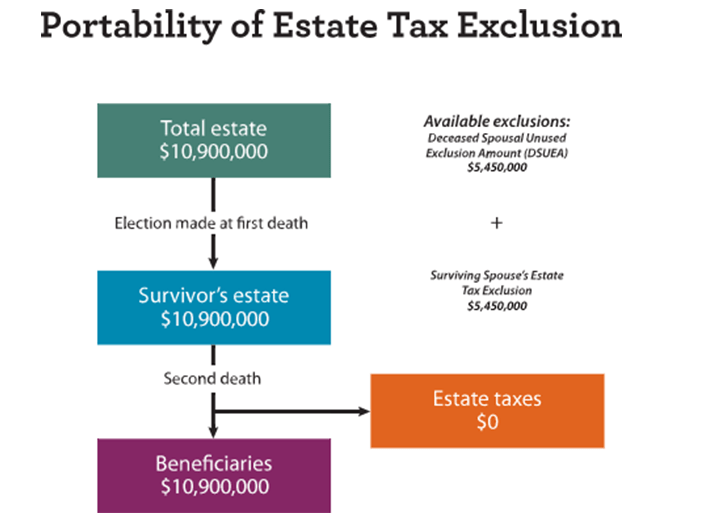
PortabilityPortability is a useful estate planning tool for married couples with estates large enough to be subject to the federal estate tax.
 
Portability is a tax election available to married couples that permits a surviving spouse to take advantage of his or her deceased spouse’s unused exemption from federal estate and gift taxes.
 
Every person has a lifetime exemption from federal estate and gift taxes. Your lifetime exemption for estate tax purposes is $5.45 million. Before portability, you had to “use or lose” that exemption. If you did not make taxable transfers in the amount of your lifetime exemption from federal estate and gift taxes, the unused exemption simply evaporated at your death.
 
Today you have the option of making the portability election. The unused exemption can be transferred to a surviving spouse, who can then use it to shelter his or her own gifts or estate from transfer taxes.
 
If you have questions about the portability election, and whether it can benefit your family, please contact my office.
 
Reference: Portability: A Useful Estate Planning Tool, JD Supra, July 28, 2016.
 

Aug 04

Estate Planning Tips for Those Approaching End of Life

End of LifeIf you (or a loved one) are approaching end of life, you may need to act quickly to prevent unnecessary expenses to your estate.
 
Planning provides peace of mind for both you and your family.
 
Here are some of the key considerations:
 
1. Prepare for Incapacity
 
Check the language of your durable power of attorney for financial matters to ensure that it is immediately effective, and that your plan can be implemented without obtaining a doctor’s letter later to certify that you are incapacitated. This will ensure that your agent can assist you as soon as you need help.
 
2. Avoid Probate and Complete Any Required Funding
 
Planning to avoid probate upon death may require a Revocable Living Trust. In order to be effective, the trust must not only be put into effect, but it must also be funded by transferring record title of real property, bank accounts and investment accounts into the trust. Failure to fund may result in a full or summary probate proceeding such as a petition to transfer the assets into the trust.
 
You should confirm that all beneficiary designations for life insurance, retirement and all annuities are completed. Failure to complete beneficiary designations for retirement accounts such as IRAs, 401(k)s, 457s and 403(b)s are particularly problematic as that may trigger unnecessary probate costs, accelerated income tax, and cause income to be taxed at a higher rate.
 
3. Consider Swapping Assets
 
Consider transferring appreciated assets with a low income basis to obtain a step up in income tax basis upon your death and transferring depreciated assets away to avoid a step down in income tax basis.
 
Consider implementing any desired charitable gifts during your lifetime if your estate is not subject to estate tax. Your lifetime exemption for estate tax purposes is $5.45 million, if you’re single, and $10.9 million for a married couple. Charitable gifts at death provide no estate tax savings for smaller estates. On the other hand, charitable transfers or gifts made during your lifetime may yield a substantial income tax savings even for the smaller estates.
 
5. Identify and Review Existing Life Insurance Policies
 
Confirm that all life insurance policies are paid and that policies have not lapsed. Reinstatement may still be possible prior to death. For a taxable estate (in excess of $5.45 million for singles or $10.9 million for married couples), consider selling the life insurance policy to an irrevocable life insurance trust (ILIT). You may even be able to stop or reduce payments due to life expectancy if the cash value is adequate.
 
6. Plan to Avoid Income in Respect of the Decedent (IRD)
 
For taxable estates, you may be able to avoid income in respect of a decedent (IRD) items, which include wages, individual retirement account distributions and other income that may be paid after death. IRD items are subject to both estate tax and income tax. While a deduction is available for income tax purposes, estate tax paid does not provide dollar for dollar protection. Note also that the estate tax deduction for the calculation of the income liability is often overlooked.
 
The steps taken to avoid income in respect to the decedent depend upon the type of income or item. For example, a Roth conversion or even an accelerated distribution from a retirement account may be appropriate if the decedent’s marginal income tax rate is lower than the beneficiary’s marginal tax rate. IRD may be avoided by transferring the IRD asset to the surviving spouse. Deferring receipt of retirement benefits will postpone receipt and tax of the IRD income. Careful planning may allow the beneficiaries to stretch the receipt of the benefits over the beneficiary’s life expectancy. Estate tax can be avoided by transferring the IRD asset to a charity in the estate plan. Careful planning is needed which should include the financial advisor and the tax advisor.
 
This is not intended to be an all-inclusive list of the issues to be considered for planning at the end of life. Each person’s situation in unique.
 
Reference: 6 Estate Planning Tips for Those Approaching Death, Nasdaq, July 26, 2016.
 

  • « Go to Previous Page
  • Page 1
  • Page 2
  • Page 3
  • Page 4
  • Page 5
  • Page 6
  • Interim pages omitted …
  • Page 30
  • Go to Next Page »

sidebar

Blog Sidebar

My name is Diana Hale, and I serve families and business owners in Denver, Colorado Springs, and the surrounding metro areas.

2000 S. Colorado Blvd.
Tower One, Suite 2000
Denver, CO 80222
Dir.: (720) 739-1799
Fax.: (888) 552-6580
Diana@HaleEstatePlanning.com

Social Media

TwitterGoogle +Linkedin

2000 S. Colorado Blvd., Tower One, Suite 2000 | Denver, CO 80222
800-686-0168 | 720-739-1799 | 719-623-5822

© 2026 Hale Law, LLC

This website includes general information about estate planning, probate, and business law. These materials are for informational purposes only. They are not intended to be legal advice regarding any particular set of facts or circumstances. You need to contact a lawyer licensed in your jurisdiction for advice regarding your specific legal issues.